



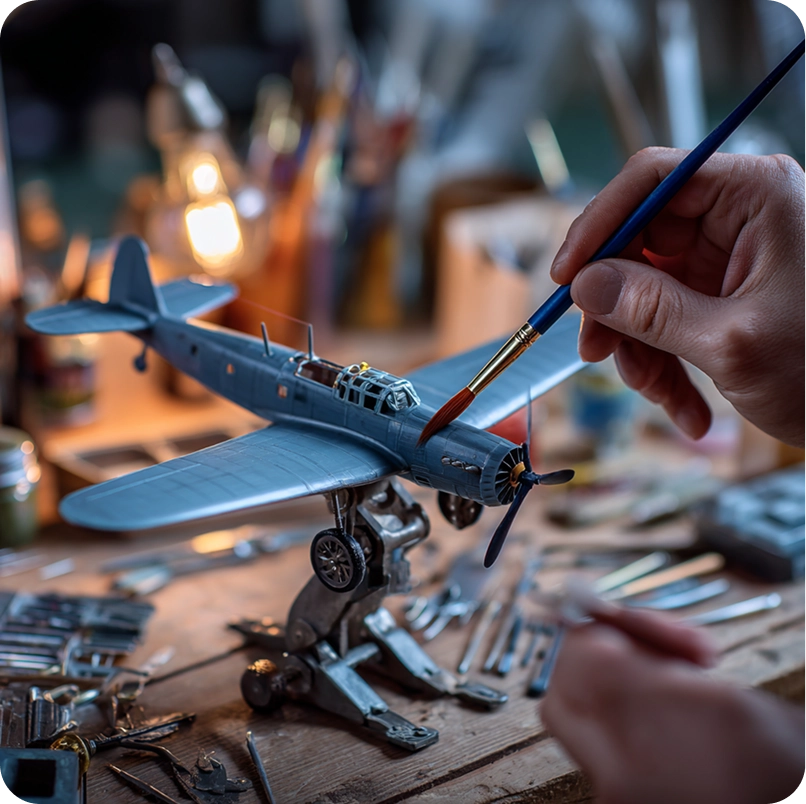
Every scale modeler knows the moment well. You open the box, pull out the sprues, and stare at the raw, grey polystyrene. It’s just plastic. It is smooth, uniform, and… inanimate.
The true magic of scale modeling doesn’t happen during assembly (though that is the essential foundation). The real alchemy begins afterwards. It is The Art of the Finish—the process where we transform a toy into a miniature replica, and turn plastic into steel, wood, canvas, or rusted iron.
How do you walk this path? How do you make your model tell a story? Here is a guide to the techniques that will breathe life into your projects.
1. The Foundation: More Than Just Color
Many beginners make the mistake of treating painting simply as "covering the plastic with color." To make a model look "alive," we must trick the viewer's eye. Real objects rarely possess a single, perfectly uniform shade.
-
Primer: This isn't just about adhesion. A good primer (grey, black, or reddish-brown) sets the tone for subsequent layers and highlights details that might otherwise be lost.
-
Preshading & Highlighting: Before applying your base coat, spray the panel lines and crevices with black or dark grey. This technique instantly adds depth and volume to the object.
Pro Tip: When applying your base coat with an airbrush, try not to cover the model 100% opaquely. Let the shadows show through faintly. This is the first breath of life in the plastic.
2. Weathering: Dirt Tells a Story
This is where the real fun begins. A clean tank looks like it belongs in a museum (or a toy factory). A dirty tank looks like it has just returned from the front lines. Weathering is your model's narrative.
The Wash (Pin Wash)
The simplest and most effective technique. Diluted oil paint or a dedicated enamel product (like a "Panel Line Wash") flows into recesses, rivets, and panel gaps.
-
The Effect: It defines the geometry and creates the illusion of shadow. The model stops looking like a single solid block.
Chipping
Real machines get scratched. Paint flakes off, exposing the primer or bare metal underneath.
-
The Sponge Method: Take a piece of packing sponge, dip it in dark grey or reddish-brown paint, dab off the excess on a paper towel, and gently "stamp" the edges of the model.
-
The Effect: An immediate sense of weight and material wear.
Oils and Streaking
Rain, grease, fuel, rust. Using oil paints, you can draw vertical lines on the sides of the hull or fuselage, then blend them downward with a brush dampened in White Spirit.
-
The Effect: Subtle surface variation that makes the plastic look like metal that has been exposed to the elements.
3. Texture: Fooling the Sense of Touch
Plastic is perfectly smooth. Reality is not. To breathe life into the model, you need to disrupt that smoothness.
-
Mud and Earth: Liquid pigments, texture pastes, or acrylic resins allow you to create three-dimensional mud on tracks or wheels. Remember: wet mud is dark and glossy; dry mud is light and matte.
-
Cast Steel Texture: For armored vehicles, stippling liquid putty onto the surface with an old brush creates the rough, pitted look of cast metal.
4. The Final Seal: Controlling the Light
Finally—the varnishes. These dictate the final perception of the model.
-
Gloss: Essential underneath decals and washes, but rarely used as a final coat (unless you are building a civilian sports car).
-
Satin: Often the most realistic finish for semi-gloss metals and leather.
-
Matt (Flat): The key to realism in military modeling. A matte surface removes the "toy-like" shine of plastic and adds "scale weight," making the miniature appear massive and heavy.
Summary: Don't Be Afraid to Mess Up
"The Art of the Finish" is a continuous learning process. Not every streak will be perfect the first time, but every layer brings you closer to realism. Remember that in modeling, mistakes can often be turned into assets—an accidental spill becomes an oil leak, and a scratch that is too deep becomes battle damage.
Your goal is not just to glue plastic together. Your goal is to make the viewer forget they are looking at plastic at all.
Are you ready to breathe life into your next project?
I can help you select the right tools for your workbench to get started. Would you like me to curate a "Starter Weathering Kit" list featuring the essential products available in your store?

